As told by Emma Ulmer, Director of Marketing at Offstreet
When Emma Ulmer joined Offstreet in the early days, conversations with university professionals were focused on innovation. “Our first 25 universities on the platform had very much an early-adopter mindset,” she says. They wanted to improve the guest experience, and that was reason enough to try something new.
As Offstreet grew and the market evolved, the conversation changed. Improving the guest experience remained valuable, but it wasn’t always enough on its own to justify new spending.“Improving the guest experience is important,but it’s not always enough when it comes to securing a budget for a new solution.”
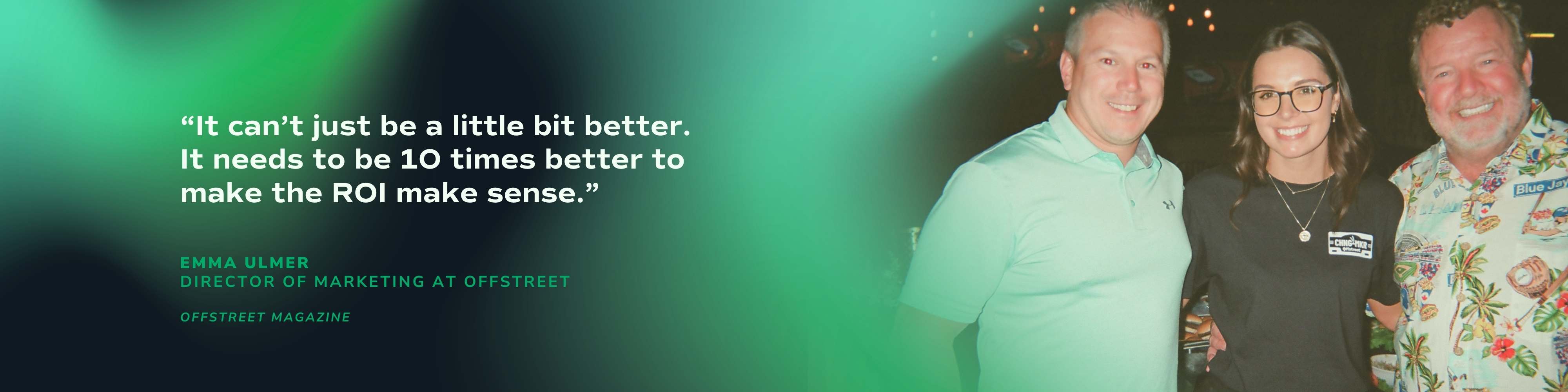
Today, cost and ROI sit at the heart of many conversations. Not because parking leaders don’t recognize the inefficiencies in their current processes—they do. It’s because the bar for change is higher. “It can’t just be a little bit better,” Emma says. “It needs to be 10 times better in order to make the ROI make sense.”
Ask Emma about “hidden costs,” and she doesn’t hesitate. Many universities underestimate the ripple effects of a clunky guest parking journey: confused visitors, more support calls, and erosion of trust between departments and the parking team. Even when schools adopt virtual permits, they often keep PDF workarounds for contractors or special use cases—speed bumps that slow enforcement and make abuse easier.
There’s also the practice of lot rentals or flat-rate event pricing. Departments estimate attendance, pay a single fee, and the lot is taken offline. Enforcement stops. Data is non-existent. Opportunities to optimize stall turnover vanish. “Renting the lot at a flat rate is the opposite of doing more with less,” Emma says. Without real numbers, it’s a guess—one that can leave money, insights, and compliance on the table.
If there’s a story that brings the ROI picture into focus, it’s the University of Manitoba. They’d invested in virtual permits and LPR enforcement, but certain cases—department guests, special events, the campus restaurant—still relied on PDF permits. “They literally had a full-time staff member whose job was basically to manage and distribute and keep track of these physical permits,” Emma recalls.
Moving those use cases into Offstreet didn’t just tidy things up. It transformed the workflow—online, reportable, auditable. The university didn’t just gain efficiency; they gained visibility. “It not only saves them time,” Emma says, “but allows them to be a lot smarter with how they issue permits for guests and events.”
Emma doesn’t lead with citation revenue. Most campuses prioritize compliance and reputation over citation revenue. Still, the numbers can be startling. “Sometimes a ticket is half the cost of a semester permit,” she says. Even a small increase in event enforcement can change the math. “Just issuing ten extra citations a month could recover costs of Offstreet for a university.”
The point isn’t to ticket more—it’s to run a system that’s fair, consistent, and data-driven. When compliance rises, so do legitimate permit sales. When abuse drops, so do headaches.
Offstreet originally priced by lot—a familiar model that made early adoption straightforward. As universities stretched the platform across campus, it created friction: adding more use cases sometimes felt like adding more cost. The company shifted to a flat-fee model to remove that brake. “It’s in their best interest to add more permits to Offstreet,” Emma explains. “We don’t charge transaction fees, so the more they use it, the more valuable it becomes.”
That change unlocked creative expansions. Schools began bringing niche permit types and edge cases onto the platform—sometimes hundreds of them. In one long-running event example, a campus discovered they could bill back 25% more plate registrations simply by charging for the actual number of parkers instead of estimates. Happy parkers. Happier budgets.
Commencements, game days, orientations—big moments stress-test whatever a campus believes about demand. Departments may predict 100 cars; the data might show 125—or 80. Offstreet replaces guesswork with facts: how many permits sold, who arrived, where enforcement should continue. With real numbers, teams can sell more accurately, enforce consistently, and end the day with clearer revenue and fewer surprises.
The dollars matter. So does everything that’s harder to quantify. Universities are being asked to “do more with less”: fewer spaces, tighter budgets, higher expectations. Time is the one lever that multiplies all the others.
“Rather than spending a lot of time issuing permits,” Emma says, “they should be spending that time analyzing the data so they can make smarter decisions.” Smoother guest experiences cut down on calls to the front desk. Cleaner processes build confidence across departments. And for prospective students and families—often encountering the university for the first time in a parking lot—a frictionless arrival sets the tone for the day.
“I think that parking can own the customer’s journey a lot more than they currently do,” Emma says. When they do, everyone feels the difference.
Struggling to see a clear business case? Here are some concluding thoughts:
And if a school still isn’t sure? “Implementing Offstreet should make financial sense,” Emma says. “Work with our team to identify the right use cases, the right starting point. Then let the results speak.”